
AC Technician Course in Pakistan

AC Technician Course in Pakistan

The Electrical Supervisor course provides students with a comprehensive understanding of electrical systems, installations, and maintenance principles and practices. Offered as part of a professional electrical training center or electrical engineering trade school, this program equips students with the necessary skills and knowledge to effectively manage electrical systems and installations. The course covers a range of topics, including electrical theory, safety, codes and regulations, electrical systems design, installation, and maintenance.

Course Overview

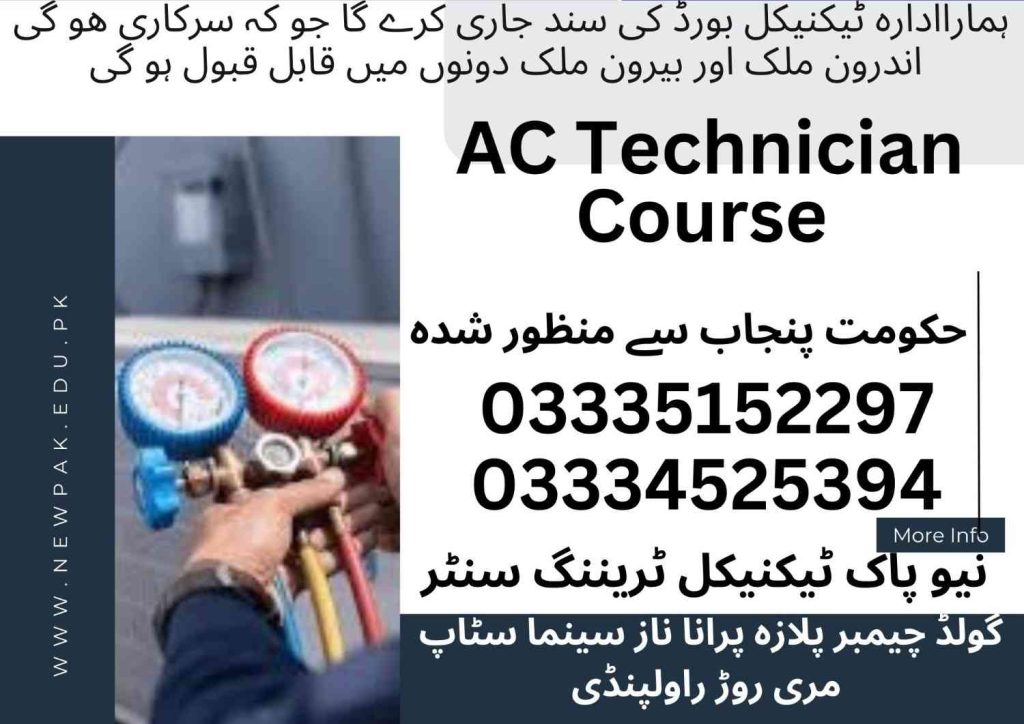
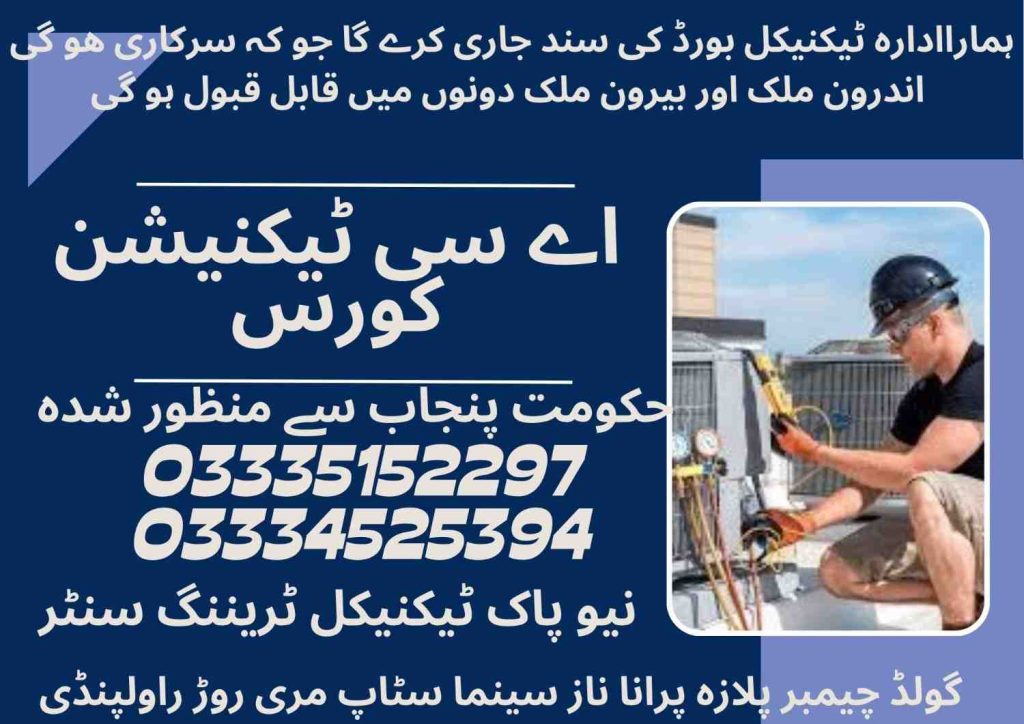
Air conditioning is no longer a luxury, it is a necessity. At New Pak Technical Training Centre, our AC Technician course is a fast-track program designed to turn you into a skilled cooling professional. We focus on the most common systems used in Pakistan and the Middle East, ensuring you can diagnose any fault and perform perfect installations from day one.

AC Technician Course in Pakistan

Why Choose Our Electrical Supervisor Program?

  • Inverter Technology Experts: Specialized training on modern Inverter ACs, including PCB troubleshooting and DC motor diagnostics.
  • Gas Charging Mastery: Learn the precise science of charging different refrigerants ($R-22, R-410A, R-32$) without wasting gas or damaging the environment.
  • Rapid Fault Finding: We teach you a “Logical Troubleshooting” method to identify electrical or mechanical issues in minutes, not hours.
  • Gulf Trade Test Ready: Our practical sessions are designed to mimic the Trade Tests conducted by recruitment agencies for Dubai, Qatar, and Saudi Arabia

Detailed Course Modules

06 | Months Certificate

Focus: Domestic installation and general repairs.

  • AC Installation: Step-by-step training on mounting indoor/outdoor units, copper piping, and vacuuming.
  • The Cooling Cycle: Practical understanding of how the Compressor, Condenser, and Evaporator work together.
  • Service & Cleaning: Mastery of “Jet Pump” service and chemical cleaning of cooling coils.
  • Electrical Basics: Wiring for AC plugs, stabilizers, and indoor-to-outdoor communication cables.

01 | Year Certificate

Focus: Advanced electronics, commercial units, and refrigerators.

  • Inverter Troubleshooting: Deep dive into the electronic “Pulse” of Inverter ACs and how to test sensor outputs.
  • Refrigerator & Deep Freezer: Comprehensive repair of domestic fridges, including capillary replacement and thermostat wiring.
  • Commercial Split & Floor Standing: Installation and servicing of high-capacity (2-ton to 5-ton) cabinet units.
  • PCB Repair Basics: Understanding the main control boards and how to identify burnt components.

Frequently Asked Questions (FAQs)

What is the difference between this and the HVAC course?

This course is a “specialized” version focusing heavily on Air Conditioners and Refrigerators. The HVAC course is broader and includes central heating and industrial ducting. This course is perfect if you want to start a shop or work as a field technician.

Yes. We have a dedicated lab with Split ACs, Window ACs, and Inverter units where you will perform actual gas charging and installations.

Many of our graduates are successfully employed as “Authorized Service Technicians” for these major brands because of our focus on modern technology.

Month 1 — Basic Refrigeration & Safety

Theory Topics

1. Introduction to Electricity

  • Definition, history & importance of electrical energy
  • Current, voltage, resistance, power, energy
  • Conductors, insulators, semiconductors
  • SI units and measurement fundamentals

2. Basic Electrical Laws

  • Ohm’s Law
  • Kirchhoff’s Laws (KCL & KVL)
  • Power and energy calculations

3. DC Circuits

  • Series, parallel, and series-parallel circuits
  • Thevenin & Norton theorem
  • Maximum power transfer theorem

4. AC Fundamentals

  • Alternating current vs direct current
  • Frequency, amplitude, phase
  • RMS values, form factor
  • Single-phase vs three-phase systems

5. Electrical Symbols & Drawings

  • Standard electrical symbols
  • Reading basic wiring diagrams

Practical Sessions

1. Multimeter Practice

  • Measuring voltage, current and resistance
  • Identifying faulty connections

2. Breadboard Circuit Building

  • Constructing simple DC circuits
  • Verifying Ohm’s law

3. AC Supply Experiments

  • Visualizing AC waveforms on CRO
  • Testing phase rotation

4. Wiring Tables and Sockets

  • Learning core identification and color coding
  • Basic house wiring panels

Competency Outcomes

  • Understand basic electrical concepts
  • Apply laws to real circuits
  • Safely use measurement tools
  • Interpret simple diagrams

Month 2 — Electrical Machines and Power Systems

Theory Topics

1. Transformers

  • Principle of operation
  • Types of transformers
  • Efficiency and losses
  • Step-up vs step-down transformers

2. DC Machines

  • Construction and working
  • Types: Shunt, Series, Compound
  • Applications in industry

3. AC Machines

  • Induction motors (single & three-phase)
  • Synchronous machines
  • Motor starters and controls

4. Power Generation & Distribution

  • Overview of power generation (thermal, hydro, renewable)
  • Grid structure in Pakistan (WAPDA/PEPCO distribution)
  • Substations and feeders

5. Power Factor & Load Management

  • Causes of poor power factor
  • Correction techniques
  • Importance for industries

Practical Sessions

1. Transformer Testing

  • Open circuit and short circuit tests
  • Determining efficiency and regulation

2. DC Motor Controls

  • Starting/Stopping
  • Load tests

3. AC Motor Installation

  • Mounting and alignment
  • Belt and coupling checks

4. Power Distribution Panel

  • Bus bar system
  • Circuit breakers and fuses
  • Labeling and safety checks

Competency Outcomes

  • Identify and operate electrical machines
  • Test transformers and motors
  • Understand distribution networks
  • Improve power factor on load systems

Month 3 — Electrical Installation & Maintenance

Theory Topics

1. Electrical Codes & Standards

  • Pakistan Standards & safety regulations
  • International standards (IEC, NEC basics)

2. Wiring Systems

  • Conduit, trunking, casing
  • Cable selection and derating
  • Earthing and bonding requirements

3. Protective Devices

  • Fuses, MCBs, MCCBs, RCDs
  • Relays and overcurrent protection
  • Coordination and selectivity

4. Lighting & Power Circuits

  • Types of lighting systems
  • Power outlets and load calculations
  • Smart lighting in modern industries

5. Preventive & Predictive Maintenance

  • Schedules and checklists
  • Fault diagnosis
  • Tools and equipment for maintenance

Practical Sessions

1. Wiring Practice

  • Office/home wiring layout
  • Conduit bending and fitting

2. Panel Building

  • Mounting MCBs/MCCBs
  • Labeling and schematic integration

3. Fault Finding Exercises

  • Break/fault simulations
  • Using test lamps and insulation testers

4. Maintenance Plan Mock Drill

  • Creating maintenance check sheets
  • Simulating preventive maintenance rounds

Competency Outcomes

  • Implement standards in installations
  • Build and maintain electrical wiring
  • Diagnose and fix common faults
  • Schedule maintenance activitie

Month 4 — Control Systems & Automation

Theory Topics

1. Basics of Control Systems

  • Open vs closed loop systems
  • Sensors and actuators

2. Motor Control

  • Starters (Direct Online, Star-Delta)
  • Contactors, Overload relays
  • Speed control techniques

3. PLC Fundamentals

  • PLC architecture
  • I/O modules and programming basics
  • Ladder logic principles

4. Automation Components

  • Relays, timers, counters
  • Human-Machine Interface (HMI)
  • SCADA basics

5. Electrical Safety in Control Rooms

  • Lockout/Tagout procedure (LOTO)
  • Safety interlocks
  • Electrical hazard mitigation

Practical Sessions

1. Control Panel Wiring

  • Wiring contactors and relays
  • Testing motor control circuits

2. PLC Programming Lab

  • Simple ladder logic
  • I/O testing
  • Timers & counters exercises

3. Automation Projects

  • Conveyor control
  • Traffic light simulation
  • Level control stations

4. Safety Simulation

  • Emergency stops
  • Safety interlock testing

Competency Outcomes

  • Design basic control circuits
  • Program PLCs for industrial tasks
  • Integrate safety in automation
  • Troubleshoot control panel

Month 5 — Industrial Electrical Practices

Theory Topics

1. Industrial Electrical Safety

  • Risk assessments
  • Safe work permits
  • PPE selection

2. Power Quality & Harmonics

  • Voltage sag/swells
  • Harmonic distortion
  • Mitigation techniques

3. Energy Management

  • Load analysis
  • Energy efficient motors
  • Demand management

4. Electrical Contracts & Documentation

  • Job estimation
  • Material take-offs (MTOs)
  • Reporting and record-keeping

5. Standards & Compliance

  • Environmental regulations
  • Factory Act and labor safety complianc

Practical Sessions

1. Safety Drills

  • Fire extinguisher training
  • Emergency evacuation

2. Power Quality Testing

  • Using power quality analyzers
  • Reading waveforms and logs

3. Energy Audit

  • On-site energy audit project
  • Recommendations report

4. Documentation Workshop

  • Writing work orders
  • Daily site reports

Competency Outcomes

  • Promote safety culture
  • Analyze power quality
  • Perform energy audits
  • Prepare professional documentation

Month 6 — Capstone Projects & Assessment

Theory Revision & Mock Tests

1. Comprehensive Theory Recap

  • All previous modules
  • Focus on weak areas
  • Model question papers

2. Regulations & Safety Quiz

  • Codes, standards, best practices
  • Scenario-based questions

3. Site Supervision Principles

  • Leadership & communication
  • Team management techniques

4. Cost Control & Budgeting Basics

  • Man-hour estimates
  • Material cost control
  • Profit & loss in electrical projects

Practical Final Assessment

1. Installation Project

  • Complete wiring of a model building
  • Panel assembly & commissioning

2. Control System Project

  • PLC automation setup
  • Documentation & presentation

3. Maintenance Project

  • Predictive maintenance plan
  • Fault diagnosis demo

4. Industry Simulation

  • Mock site supervision
  • Real-time problem solving
WhatsApp (051) 5537634 YouTube Google Maps