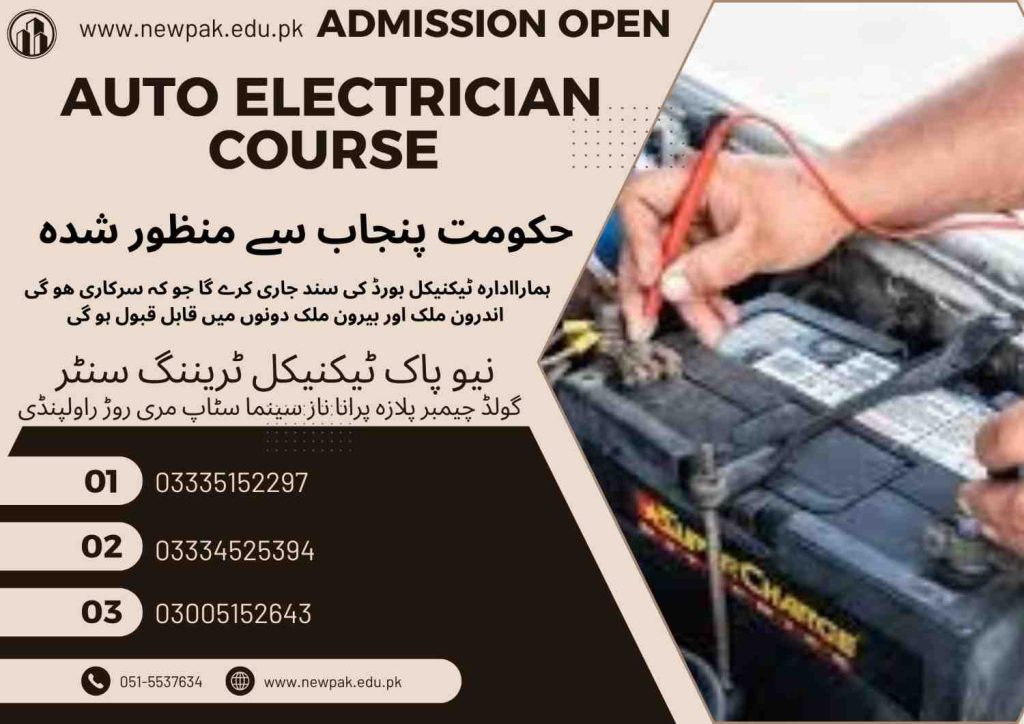

Auto Electrician Course in Pakistan

Auto Electrician Course in Pakistan

The Electrical Supervisor course provides students with a comprehensive understanding of electrical systems, installations, and maintenance principles and practices. Offered as part of a professional electrical training center or electrical engineering trade school, this program equips students with the necessary skills and knowledge to effectively manage electrical systems and installations. The course covers a range of topics, including electrical theory, safety, codes and regulations, electrical systems design, installation, and maintenance.

Course Overview

Modern vehicles are no longer just mechanical; they are advanced electronic machines. At New Pak Technical Training Centre, our Auto Electrician course bridges the gap between traditional wiring and modern EFI (Electronic Fuel Injection) systems. We train you to diagnose, repair, and maintain the complex electrical heart of cars, SUVs, and heavy vehicles.

Auto Electrician Course in Pakistan

Why Choose Our Electrical Supervisor Program?

  • EFI & Computer Scanning: Learn to use professional OBD-II scanners to diagnose engine faults.
  • Modern Lab Facility: Get hands-on experience with actual car wiring harnesses, sensors, and ECUs.
  • Global Career Opportunities: Skilled Auto Electricians are in high demand in Dubai, Qatar, and Saudi Arabia, especially those who understand Japanese and European vehicle systems.
  • Hybrid Technology: Introduction to Hybrid and Electric Vehicle (EV) battery systems.

Detailed Course Modules

06 | Months Certificate

Focus: Traditional wiring and essential vehicle electronics.

  • Vehicle Wiring Fundamentals: Understanding 12V/24V systems, fuses, relays, and switches.
  • Starting & Charging Systems: Complete repair and maintenance of Self-Motors (Starters) and Alternators.
  • Lighting & Accessories: Wiring for headlights, indicators, central locking, and power windows.
  • Battery Management: Testing, charging, and maintaining lead-acid and dry batteries.

01 | Year Certificate

Focus: Computerized diagnostics and engine management.

  • EFI Technology: Comprehensive study of sensors (MAF, Oxygen, MAP, Crank/Cam) and Injectors.
  • ECU Diagnostics: Learning to read and clear “Check Engine” codes using professional scanners.
  • Air Conditioning Electronics: Troubleshooting climate control and AC compressor wiring.
  • ABS & Airbag Systems: Basic understanding of safety electronics and sensor calibration.

Frequently Asked Questions (FAQs)

Will I learn how to use a scanning tool?

Yes, our course includes full training on using computerized diagnostic scanners to find hidden faults in modern EFI cars.

While we focus on cars and SUVs, the principles you learn apply to heavy machinery and trucks as well, which is great for those looking for industrial jobs.

Absolutely. We provide you with the technical and practical knowledge required to open your own EFI and Auto Electrician shop.

Month 1 — Basic Electricity & Auto Workshop Safety

Theory Topics

1. Introduction to Auto Electrician Trade

  • Scope of Auto Electrician in Pakistan
  • Career opportunities (Workshop, Dealership, Freelancing)
  • Role and responsibilities of an Auto Electrician

2. Basic Electricity Fundamentals

  • Definition of electricity
  • Types of electricity (Static & Current)
  • Electric current, voltage, resistance
  • Ohm’s Law and its applications

3. Electrical Units and Symbols

  • Ampere, Volt, Ohm, Watt
  • Electrical symbols used in auto wiring diagrams

4. Tools and Equipment

  • Hand tools (pliers, screwdrivers, spanners)
  • Measuring tools (Multimeter, Test Lamp)
  • Power tools (drill machine, soldering iron)

5. Auto Workshop Safety

  • Personal protective equipment (PPE)
  • Electrical safety precautions
  • Fire hazards and fire extinguishers
  • Battery safety and acid handling

Practical Sessions

  • Identification of tools and equipment
  • Practice of safe workshop procedures
  • Use of multimeter (Voltage, Current, Resistance)
  • Making simple series and parallel circuits
  • Reading basic electrical diagrams

Month 2 — Electrical Machines and Power Systems

Theory Topics

1. Automotive Battery

  • Types of batteries (Lead-acid, Dry battery)
  • Construction of battery
  • Battery capacity and ratings
  • Battery charging principles
  • Common battery faults and causes

2. Charging System

  • Purpose of charging system
  • Alternator construction and working
  • Voltage regulator function
  • Charging system wiring

3.  Starting System

  • Purpose of starting system
  • Starter motor construction
  • Solenoid switch
  • Starting circuit diagram
  • Common starter faults

Practical Sessions

  • Battery inspection and testing
  • Battery charging practice
  • Removing and installing battery
  • Testing alternator output
  • Starter motor removal and installation
  • Diagnosing charging and starting faults

Month 3 — Ignition System & Engine Electrical Components

Theory Topics

1. Ignition System Basics

  • Purpose of ignition system
  • Types of ignition systems
      • Conventional ignition
      • Electronic ignition

2. Components of Ignition System

  • Ignition coil
  • Distributor
  • Spark plugs
  • Ignition switch

3. Spark Plug Theory

  • Types of spark plugs
  • Heat range
  • Spark plug gap

4.  Sensors and Switches

  • Crankshaft position sensor
  • Camshaft sensor
  • Temperature sensor

Practical Sessions

  • Checking and cleaning spark plugs
  • Setting spark plug gap
  • Testing ignition coil
  • Distributor timing adjustment
  • Identifying engine sensors
  • Basic ignition fault diagnosis

Month 4 — Lighting System, Accessories & Wiring

Theory Topics

1. Vehicle Lighting System

  • Head lights (Halogen, LED)
  • Tail lights and brake lights
  • Indicators and hazard lights
  • Fog lamps

2. Accessories System

  • Horn system
  • Wiper and washer system
  • Power windows
  • Central locking system

3. Auto Wiring

  • Types of wires
  • Wire color codes
  • Fuses and relays
  • Wiring harness

4. Circuit Protection

  • Fuse box
  • Relay operation
  • Short circuit and open circuit

Practical Sessions

  • Headlight alignment
  • Replacing bulbs and fuses
  • Wiring practice on boards
  • Relay testing and replacement
  • Horn and wiper fault repair
  • Making wiring harness

Month 5 — Electronic Systems & Diagnostic Skills

Theory Topics

1. Introduction to Automotive Electronics

  • Difference between electrical and electronic systems
  • ECU (Engine Control Unit) overview

2. Fuel Injection System (Basic)

  • Sensors and actuators
  • Electronic fuel pump
  • Injector basics

3. OBD (On-Board Diagnostics)

  • Purpose of OBD system
  • Error codes and meanings

4. Modern Vehicle Systems

  • ABS overview
  • Airbag system basics
  • Immobilizer system

Practical Sessions

  • Using diagnostic scanner
  • Reading and clearing fault codes
  • Checking sensors with multimeter
  • Fuel pump testing
  • Basic ECU wiring identification

Month 6 — Advanced Auto Electrical Work & Entrepreneurship

Theory Topics

1. Advanced Electrical Fault Finding

  • Troubleshooting techniques
  • Reading complex wiring diagrams

2. Hybrid & New Technology Overview

  • Introduction to hybrid vehicles
  • Safety precautions in hybrid systems

3. Workshop Management

  • Customer dealing
  • Job card preparation
  • Cost estimation

4. Entrepreneurship & Self-Employment

  • Setting up auto electrician workshop
  • Tools and equipment investment
  • Marketing and customer relations

5. Health, Safety & Environment

  • Waste management
  • Environmental protection

Practical Final Assessment

  • Complete vehicle electrical inspection
  • Complex fault diagnosis practice
  • Real vehicle repair projects
  • Customer handling simulation
  • Final practical assessment
WhatsApp (051) 5537634 YouTube Google Maps