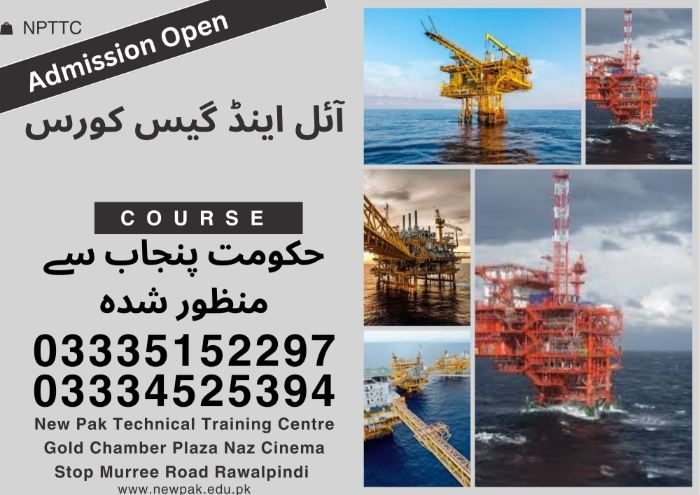
The energy sector drives the global economy, and skilled professionals are in high demand. At New Pak Technical Training Centre, this course equips you with the technical, operational, and safety skills required to work across the oil and gas industry, from exploration and drilling to refining and pipeline, preparing you for a professional career in Pakistan and the Gulf.
Course Overview
The energy sector is the engine of the global economy. At New Pak Technical Training Centre, our Oil & Gas course provides a comprehensive roadmap of the industry, from the moment oil is discovered underground to the final refining process. We focus on the technical, operational, and safety skills required to work in the high-stakes environments of oil rigs, refineries, and pipelines.
Why Choose Our Oil and Gas Program?
Upstream to Downstream Mastery: Learn the entire lifecycle, including Exploration, Drilling, Production, and Refining.
Global Safety Standards: Extensive focus on HSE (Health, Safety, and Environment), preparing you for international certifications like NEBOSH or OSHA.
Gulf Career Focus: Specifically designed for the massive energy markets of Saudi Arabia, Kuwait, and Qatar.
Modern Technology: Understand the latest in directional drilling, offshore operations, and digital oilfield automation.
Detailed Course Modules
06 | Months Certificate
Focus: Fundamental operations and safety.
Introduction to the Industry: Understanding the global energy structure and the history of petroleum.
Drilling Techniques: Mastering rotary drilling, rig components, and onshore vs. offshore methods.
Production Fundamentals: Learning about primary and secondary recovery and artificial lift systems.
HSE Core Training: Risk assessment, fire safety, and Hydrogen Sulfide ($H_2S$) awareness.
01 | Year Certificate
Focus: Advanced engineering, refining, and leadership.
Reservoir Geology: seismic surveys and identifying rock formations that hold hydrocarbons.
Refinery Operations: The process of converting crude oil into petrol, diesel, and aviation fuel.
Pipeline & Midstream: Design and maintenance of transportation networks and storage terminals.
Petrochemicals: Understanding the by-products used in plastics, fertilizers, and fibers.
Enhanced Oil Recovery (EOR): Advanced thermal and chemical flooding techniques to maximize field output.
Frequently Asked Questions (FAQs)
Do I Need a Background in Science?
A basic background (Matric/Intermediate) is helpful, but we start from the absolute basics of industry terminology and technology.
What Job Roles Can I Apply for After This?
You can work as a Drilling Technician, HSE Officer, Refinery Operator, or Pipeline Supervisor in companies like OGDCL, ARAMCO, or ADNOC.
Is the Certificate Helpful for Overseas Jobs?
Yes. This course is specifically built to prepare you for the technical interviews and safety certifications required by multinational energy corporations in the Middle East.
Month 1 — Introduction to Oil & Gas Industry
1. Theory
Overview of Oil & Gas Industry in Pakistan and globally.
History of oil and gas exploration.
Classification of hydrocarbons – oil, gas, condensates.
Upstream, midstream, and downstream sectors.
Basic chemistry of petroleum.
Physical properties of crude oil and natural gas.
Understanding reserves and resources.
2. Practical
Familiarization with oilfield equipment.
Lab exercises: identifying crude oil types.
Introduction to petroleum products.
Site visit to a local gas station or small refinery.
3. Learning Outcomes
Understand the structure of the Oil & Gas sector.
Identify types of hydrocarbons and their properties.
Month 2 — Exploration & Drilling Operations
1. Theory
Geology and geophysics basics.
Seismic surveys and mapping.
Exploration methods: onshore and offshore.
Drilling fundamentals: types of drilling rigs (land & offshore).
Drilling fluids and mud systems.
Casing, cementing, and well design.
Introduction to directional drilling and well logging.
2. Practical
Reading and interpreting geological maps.
Seismic data interpretation exercises.
Handling drilling equipment simulations.
Mud preparation and testing in lab.
Observation of rig operations via video/field visit.
3. Learning Outcomes
Basic knowledge of oil & gas exploration and drilling.
Understand drilling mud properties and well design principles.
Month 3 — Production & Well Operations
1. Theory
Well completion techniques.
Artificial lift methods: gas lift, ESP, rod pump.
Well monitoring and maintenance.
Production equipment and facilities.
Separation processes: oil, gas, and water.
Storage and transportation basics.
Flow assurance and corrosion management.
2. Practical
Setting up mini oil separation units.
Measuring production rate in lab simulation.
Installing and testing artificial lift systems.
Hands-on with wellhead equipment.
3. Learning Outcomes
Understanding production systems.
Ability to handle basic well operations and monitoring.
Month 4 — Midstream Operations & Pipelines
1. Theory
Oil & gas transportation methods.
Pipeline types, components, and maintenance.
Pumping and compressor stations.
Storage tanks and terminals.
Gas processing and liquefaction basics.
Introduction to LNG and CNG.
Safety and environmental regulations for pipelines.
2. Practical
Pipeline inspection exercises.
Flow measurement and pressure testing.
Demonstration of storage tank operations.
Mini-project: designing a small pipeline layout.
3. Learning Outcomes
Understand midstream operations and pipeline safety.
Learn basic flow calculations and storage techniques.