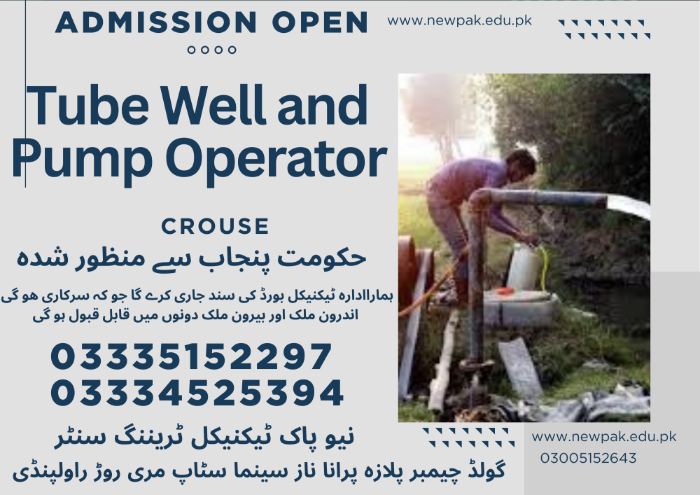
A Tube Well and Pump Operator course trains you to operate, maintain, troubleshoot, and service water pumps and tube well systems, commonly used for irrigation, municipal water supplies, and agricultural use. It combines theory (classroom) lessons with practical hands‑on training in real equipment and field settings. Typical entry requirements often ask for at least Matric/Intermediate with science, though specific centers may vary.
Course Overview
Water supply systems are critical for agriculture, housing societies, and industrial plants. At New Pak Technical Training Centre, we provide specialized technical training for Tubewell and Pump Operation. This course is designed to create skilled professionals who can install, operate, and maintain various types of water pumping systems used globally.
Why Choose Our Pump Operator Program?
Technical Expertise: Gain deep knowledge of mechanical and electrical components of water systems.
Industrial & Agricultural Demand: Huge job market in Pakistan’s agricultural sector and construction industry.
Overseas Opportunities: High demand for “Pump Technicians” in the Gulf (UAE, Saudi Arabia) for irrigation and construction projects.
Modern Equipment: Hands-on training with Submersible, Centrifugal, and Turbine pumps.
Drawing & Schematics: Expert-level reading of Single Line Diagrams (SLD), panel schedules, and architectural electrical plans.
Team Supervision: Methods for assigning tasks, inspecting work quality, and conducting on-site technical briefings.
Testing & Commissioning: Using advanced meters to verify earthing, insulation resistance, and circuit integrity before handover.
01 | Year Certificate
Focus: Large-scale water systems and heavy machinery.
Tubewell Installation: Understanding boring processes, casing pipes, and strainer placement.
Deep Well Turbine Pumps: Installation and troubleshooting of heavy-duty turbine systems.
Electrical Panels: Designing and repairing Star-Delta starters and auto-control panels for large motors.
Advanced Troubleshooting: Diagnosing motor burnouts, bearing failures, and cavitation issues.
Solar Water Systems: Basic introduction to Solar-powered tubewell installations.
Frequently Asked Questions (FAQs)
What Kind of Jobs Can I Get After This Course?
You can work as a Pump Operator in Housing Societies, Industrial Plants, Government Water Departments (WASA), or as a specialized technician in the Middle East.
Do You Teach the Electrical Side of Pumps?
Yes. Since pumps run on electricity, we provide comprehensive training on motor wiring, control panels, and safety breakers.
Is This Course Suitable for Those Going to Saudi Arabia?
Absolutely. This is a high-demand skill for Saudi Arabian agricultural farms and large-scale infrastructure projects.
Six Month Course
(Short/Standard Track)
Month 1 — Introduction & Basics
Tube well concepts & water source fundamentals
Types of pumps (centrifugal, submersible) & applications
Month 2 — Installation & Setup
Installation of centrifugal and submersible pumps
Pipe fitting, motor attachment
Basic electrical wiring for pumps
Month 3 — Electrical & Safety
Electric motor fundamentals
Power supply & wiring safety
Operator safety protocols in pump work
Month 4 — Troubleshooting & Maintenance
Identifying common faults
Low water level detection
Preventive maintenance routines
Month 5 — Practical Adjustments
Valve setting, pipe adjustment
Pump testing, operational adjustments
Field work with actual systems
Month 6 — Assessment & Certification
Practical tests on real systems
Final theory exam
Certificate awarding on passing
Outcome: You’ll be able to operate and maintain different pump types safely, troubleshoot most common issues, and perform basic preventive care.
One Year Course
(Advanced Track)
Months 7–8 — Advanced Repairs & Troubleshooting
Deep dive into motor repairs
Complex fault detection techniques
Month 9 — Field System Setup Practices
Full system installation in real environments
Field diagnostics
Month 10 — Monitoring & Flow Systems
Water flow measurement
Performance tracking systems
Months 11–12 — Revision & Final Exams
Review modules
Comprehensive practical project
Final certification test
Outcomes: Greater confidence in independent operations, better problem‑solving skills, and experience with field projects and real installations.
Theory vs. Practical — What You Learn
1. Theory
Pump types and principles (centrifugal, submersible, etc.)
Water source dynamics & water level basics
Electrical basics essential to pump systems
Safety procedures, hazard awareness
Preventive vs corrective maintenance concepts
2. Practical
Installing different pump systems
Pipe fitting and alignment
Wiring and motor connections
Testing and troubleshooting real pump setups
Water level testing and protection against dry run
Employment & Certification
Employment & Skills Outcome
After completion you’ll be prepared for jobs such as:
Tube well operator
Pump Operator (Agriculture & Municipal)
Field maintenance technician
Tube Well Assistant
Water Supply System Technician
Irrigation Support Staff
Water supply operations roles in agriculture, farms, and municipal systems
Certification & Recognition
Courses structured by PSDF (Punjab Skills Development Fund) offer nationally recognized certificates, increasing employability in government and private sectors.
Some training centers also provide certification after practical and written exams
Potential employers include:
Municipal authorities
Parks & horticulture departments
Agriculture sectors/farms
Factories needing water system maintenance
Where You Can Train:
PSDF‑affiliated institutes in many cities (including Rawalpindi/Islamabad) offer the Tube Well & Pump Operator course with theory and practical sessions.
Many technical training centers across Pakistan also offer similar programs, check specific campuses for fee, schedule, and hands‑on labs.
Entry Requirements: Usually Matric/Intermediate with science, but some centers may accept candidates with equivalent vocational experience.