Motorcycle Mechanic Course in Pakistan

Motorcycle Mechanic Course in Pakistan

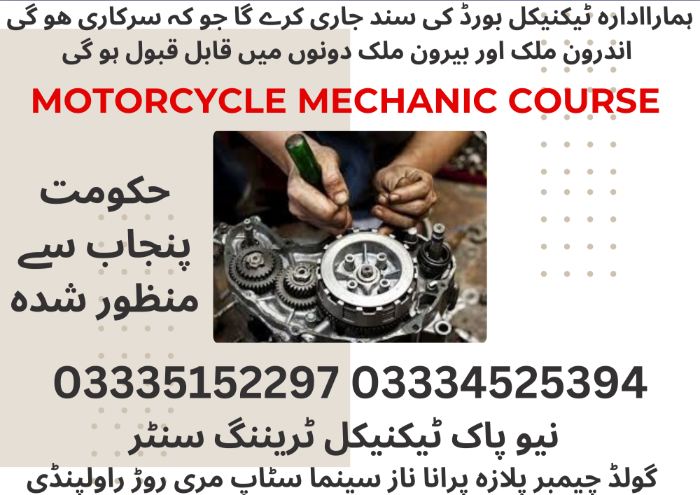
With millions of motorcycles on the road, the demand for skilled mechanics is higher than ever. At New Pak Technical Training Centre, this course trains you in the mechanics, electronics, and performance tuning of all motorcycles, from classic 70cc bikes to modern high-performance and heavy motorcycles, preparing you for a professional career in repair, maintenance, and workshop management.

Course Overview

With millions of motorcycles on the road, the demand for skilled mechanics is at an all-time high. At New Pak Technical Training Centre, we offer a specialized course that covers everything from classic 70cc engines to modern, high-performance, and heavy bikes. We turn you into a technician who understands the mechanics, electronics, and performance tuning of every motorcycle.

Motorcycle Mechanic Course in Pakistan

Why Choose Our Motorcycle Mechanic Program?

  • Comprehensive Engine Training: Hands-on experience with both 2-stroke and 4-stroke engine technology.
  • Modern Tool Mastery: Learn to use specialized pullers, torque wrenches, and engine diagnostic tools.
  • Fuel Efficiency Specialist: Focus on carburetor tuning and an introduction to EFI (Electronic Fuel Injection) in modern bikes.
  • Entrepreneurial Skills: We don’t just teach you how to fix bikes; we teach you how to manage your own workshop successfully.

Detailed Course Modules

06 | Months Certificate

Focus: Routine maintenance and basic engine repair.

  • Engine Fundamentals: Dismantling and assembling 70cc and 125cc engines.
  • Fuel & Air Systems: Carburetor cleaning, adjustment, and fuel pump maintenance.
  • Braking & Suspension: Servicing drum and disc brakes, and overhauling front/rear shock absorbers.
  • Electrical System: Wiring for CDI units, spark plugs, ignition coils, and lighting systems.

01 | Year Certificate

Focus: Performance tuning and advanced engine overhauling.

  • Engine Rebuilding: Complete overhauling of high-displacement engines (150cc to heavy bikes).
  • Transmission Systems: Mastery of multi-plate clutches and complex gearbox mechanisms.
  • Advanced Diagnostics: Troubleshooting starting problems, engine noise, and performance lags.
  • Modern Innovations: Introduction to EFI motorcycle systems, ABS brakes, and digital meters.

Frequently Asked Questions (FAQs)

Will I Learn How to Repair Different Brands Like Honda, Yamaha, and Suzuki?

Yes, our training is universal. You will learn the mechanical principles that apply to all major motorcycle brands found in Pakistan and the Gulf.

Yes, specifically in the UAE and Saudi Arabia, there is a massive demand for mechanics to maintain delivery bike fleets.

No. This is a purely technical and practical course. Anyone with a passion for bikes and a basic school education (Middle/Matric) can join.

Month 1 — Introduction & Workshop Fundamentals

Theory Topics (Approx 25 hrs)

1. Introduction to Motorcycle Mechanics

  • What a motorcycle mechanic does
  • Career paths & opportunities
  • Importance of proper maintenance
  • Overview of 2-stroke vs 4-stroke engines
  • Safety and professional conduct in the workshop

2. Workshop Safety Principles

  • Personal Protective Equipment (PPE)
  • Fire safety
  • Handling fuels and oils
  • First-aid basics
  • Fire extinguishers, proper ventilation

3. Tool Identification & Usage

  • Hand tools (sockets, spanners, screwdrivers, pliers)

  • Measuring tools (feeler gauges, micrometers, torque wrenches)
  • Workshop machines (bench grinder, drill press)
  • Tool care and storage
  • Standard operating procedures

4. Motorcycle Systems Overview

  • Engine systems, fuel system, ignition
  • Transmission & final drive
  • Braking and suspension basics
  • Electrical system introduction

Practical Sessions (Approx 100 hrs)

1. Workshop Setup & Housekeeping

  • Arrange tools, organize workstation
  • Proper disposal of waste and oil
  • Clean workspace at end of day

2. Tool Practice

  • Recognizing tools by name and use
  • Measuring tolerance on parts
  • Torque application practice

3. Safety Drills

  • Fire drill simulation
  • PPE inspection & proper wear

Month 2 — Engine Fundamentals & Fuel Systems

Theory Topics (Approx 25 hrs)

1. Engine Operating Principles

  • Four-Stroke cycle: intake, compression, combustion, exhaust
  • Two-Stroke cycle basics
  • Compression ratio, power stroke
  • Cooling systems, air & oil cooling
  • Performance factors (fuel, spark, compression)

2. Components of the Engine

  • Cylinder, piston, rings
  • Crankshaft & bearings
  • Valves and camshaft

3. Fuel Systems: Carburetor & Injection

  • Fuel delivery basics
  • Carburetor parts, float level, jets
  • Fuel pump functions
  • Basics of EFI (Electronic Fuel Injection)

Practical Sessions (Approx 100 hrs)

1. Engine Strip & Assembly

  • Remove engine from frame
  • Disassemble top-end components
  • Clean & inspect parts
  • Check for wear & damage
  • Reassemble with correct torque

2. Carburetor Service

  • Float adjustment
  • Jet cleaning
  • Idle mixture setting

3. Fuel System Tasks

  • Fuel pump inspection
  • Fuel filter change
  • Fuel line leak checks
  • EFI basics practice (if available)

Month 3 — Electrical & Ignition Systems

Theory Topics (Approx 20 hrs)

1. Electrical System Basics

  • Voltage, current, resistance fundamentals
  • Battery types, charging, maintenance
  • Wiring diagrams & color codes
  • Connectors, fuses, breakers

2. Ignition System

  • Spark plug basics
  • Ignition coils & stator
  • Points & CDI ignition
  • Timing advance/retard theory

3. Lighting & Accessories

  • Headlights, tail lights, indicators
  • Horn wiring
  • Indicators and switchgear basics

Practical Sessions (Approx 120 hrs)

1. Battery Service

  • Charge & discharge tests
  • Load testing
  • Cleaning terminals
  • Electrolyte checks (where applicable)

2. Ignition Troubleshooting

  • Spark plug check
  • Coil & CDI testing
  • Ignition timing adjustment

3. Wiring Tasks

  • Reading wiring diagrams
  • Repairing broken wires
  • Replacing connectors
  • Installing accessories

Month 4 — Transmission, Clutch & Drive System

Theory Topics (Approx 20 hrs)

1. Clutch System

  • Function of clutch
  • Types of clutches
  • Clutch adjustment theory
  • Slippage & wear indicators

2. Gear System & Transmission

  • Gearbox types
  • Gear ratios
  • Shift mechanisms
  • Troubleshooting gear engagement

3. Final Drive & Chain

  • Chain or belt drive basics
  • Sprocket wear
  • Correct tension

Practical Sessions (Approx 120 hrs)

1. Clutch Overhaul

  • Remove clutch assembly
  • Check plates, springs
  • Adjust clutch cable
  • Reassemble & test

2. Transmission Practice

  • Remove gear set
  • Check synchromesh (if present)
  • Lubrication refill
  • Trial shifting on stand

3. Chain & Sprocket Maintenance

  • Adjust tension
  • Replace worn parts

Month 5 — Brakes, Suspension & Wheels

Theory Topics (Approx 20 hrs)

1. Brake Systems

  • Drum vs disc brakes
  • Hydraulic systems
  • Brake fluid basics
  • Brake bleeding

2. Wheels & Tires

  • Tire sizes & speed indices
  • Tread wear & pressure
  • Tube vs tubeless

3. Suspension Basics

  • Front forks function
  • Rear shock absorbers
  • Spring preload basics
  • Common issues & diagnosis

Practical Sessions (Approx 130 hrs)

1. Brake Overhaul

  • Adjust brake shoes
  • Disc pad inspection
  • Bleed & refill hydraulic lines
  • Test braking efficiency

2. Suspension Servicing

  • Front fork disassemble
  • Fork oil change
  • Rear shock inspection
  • Bushing & seal checks

3. Wheel Work

  • Tire mounting & balance
  • Tube inspection
  • Spoke tensioning (where applicable)
  • Wheel alignment basics

Month 6 — Diagnostics, Tuning & Final Assessment

Theory Topics (Approx 15 hrs)

1. Fault Diagnosis Theory

  • Symptoms vs causes charting
  • Engine running issues
  • Electrical troubleshooting
  • Customer reporting skills

2. Advanced Topics

  • Emission basics
  • Performance tuning
  • Fuel economy tips
  • Workshop record keeping

3. Business & Ethics

  • Customer service
  • Pricing your services
  • Warranty basics
  • Ethical repairs & safety

Practical Final Assessment (Approx 130 hrs)

1. System-by-System Diagnostic Projects

  • Ignition faults
  • Fuel delivery issues
  • Electrical gremlins
  • Brake inefficiencies

2. Tune-Up Sessions

  • Valve clearance checks
  • Carburetor synchronization
  • Spark timing fine-tune

3. Final Assessment

  • Written test (Theory)
  • Practical demonstration
WhatsApp (051) 5537634 YouTube Google Maps