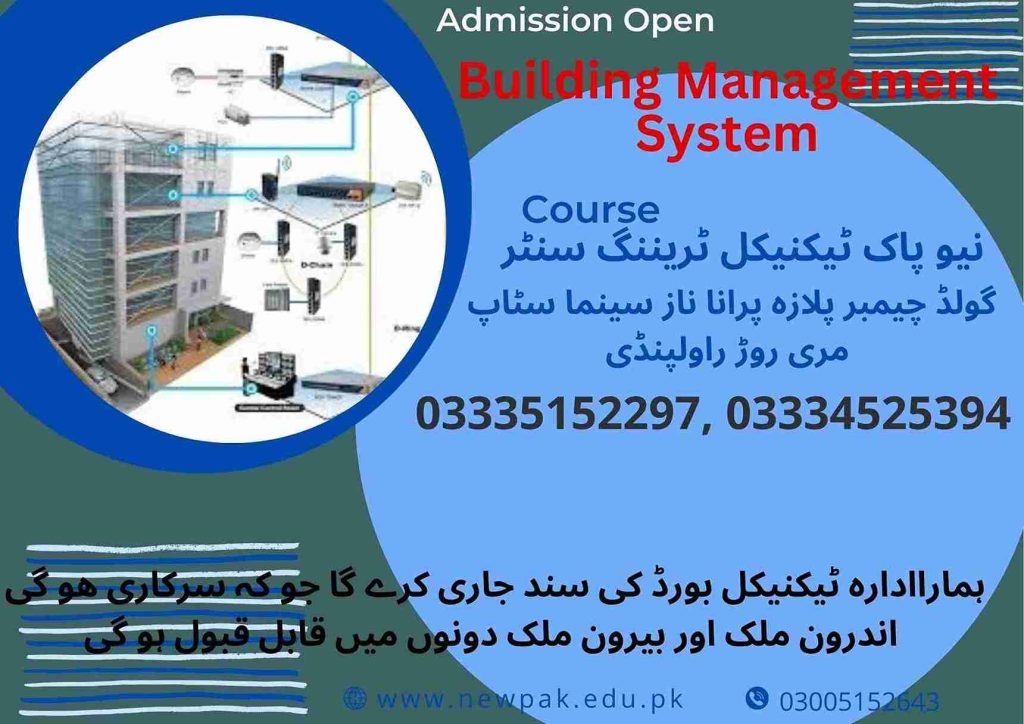
Building Management System (BMS) Course in Rawalpindi Islamabad
A Building Management System (BMS) is the backbone of modern smart buildings, controlling HVAC, lighting, power, and safety systems from one intelligent platform. This BMS Course in Rawalpindi Islamabad equips beginners and junior technicians with in-demand automation skills, opening strong career paths in commercial buildings, smart cities, and Gulf-region infrastructure projects.
Course Overview
A modern building is a complex machine, and the Building Management System (BMS) is its intelligent brain. At New Pak Technical Training Centre, we prepare you for the cutting edge of building automation. This course covers the integration of HVAC, lighting, security, and power systems into a centralized digital platform. As the world pivots toward sustainable “Smart Cities,” BMS specialists are in unprecedented demand to manage energy efficiency and operational safety in high-rise structures and industrial plants.
Key Learning Benefits
- Global Standard Protocols: Master industry-leading communication protocols including BACnet, Modbus, and LonWorks.
- Energy Optimization: Learn to implement control strategies that significantly reduce a building’s carbon footprint and electricity costs.
- Integrated Security & Safety: Gain the skills to link Fire Alarms, CCTV, and Access Control into a unified management dashboard.
- Career Readiness for 2026: Specifically designed to meet the technical requirements of massive infrastructure projects like NEOM (Saudi Arabia) and high-tech developments in Dubai and Qatar.
Detailed Course Modules
06 | Months Certificate
Focus: Hardware Installation & Field Level Diagnostics.
- BMS Architecture Foundations: Introduction to the 3-tier hierarchy: Management, Control, and Field levels.
- Field Device Mastery: Hands-on installation of temperature, humidity, $CO_2$, and pressure sensors.
- Actuators & Control Valves: Understanding the mechanics of dampers and valves in automated air and water flow.
- DDC Panel Wiring: Professional wiring techniques for Digital Inputs (DI), Digital Outputs (DO), Analog Inputs (AI), and Analog Outputs (AO).
- Basic IP Networking: Configuring routers, switches, and RJ45 terminations for building networks
01 | Year Certificate
Focus: System Programming, Integration, and Commissioning.
- Advanced Logic Programming: Writing complex control sequences for Chillers, Air Handling Units (AHUs), and Boilers.
- HMI & Graphics Development: Designing high-quality 3D graphical interfaces for real-time building monitoring.
- Multi-System Integration: Connecting ELV (Extra Low Voltage) systems like Fire Alarms and Elevators into the central BMS.
- System Commissioning: Mastering the “Testing & Commissioning” phase to ensure all automated sequences meet design specs.
- Data Analytics & Troubleshooting: Using trend logs and alarm history to perform predictive maintenance and system optimization.
Frequently Asked Questions (FAQs)
Do I Need an Engineering Degree to Enroll?
While beneficial, a degree is not mandatory. We start from the basics. Candidates with a background in Electrical, Mechanical, or Electronics (DAE/Intermediate) are ideal for this specialization.
What Are the Career Prospects in the Middle East?
The Gulf region is the largest market for BMS. Most modern towers and government projects require certified BMS Operators and Engineers. Salaries for specialists are significantly higher than for general maintenance staff.
Will I Get Practical Experience With Real Hardware?
Yes. Our lab is equipped with actual DDC Controllers and simulation rigs where you will wire, program, and test real-world scenarios.

Month 1 — Introduction & Fundamentals
Week 1 — Introduction to BMS (Theory)
Theory
- What is a BMS?
- Purpose & importance (energy savings, comfort, safety)
- Difference: BMS vs. SCADA vs. EMS vs. HVAC
- Key building systems controlled by BMS
- Stakeholders: Owners, facility managers, engineers
Week 2 — Core Concepts of Control Systems
Theory
- Open vs. closed loop control
- Sensors, actuators, controllers
- Feedback control basics
- Set points, control parameters
- Examples in HVAC, lighting
Week 3 — BMS Architecture
Theory
- Centralized vs. decentralized systems
- Field devices (sensors, relays, modules)
- Controllers: DDC/PLC basics
- I/O modules
- System topologies & redundancy
Week 4 — BMS Benefits & Applications
Theory
- Energy efficiency case studies
- IAQ (Indoor Air Quality)
- Maintenance & alarm management
- BMS in commercial vs. industrial buildings
Practical (Weeks 1–4)
Lab 1 — Identify BMS Components
- Identify sensors, actuators, controllers
- Understand part numbers & datasheets
Lab 2 — Basic Tools & Safety
- Multimeter, clamp meter use
- Electrical safety, wiring standards
Month 2 — Sensors, Actuators, and Field Devices
Week 5 — Temperature & Humidity Sensors
Theory
- Types (thermistors, RTDs, digital sensors)
- Calibration and error sources
- Placement and accuracy
Week 6 — Pressure, Flow & CO₂ Sensors
Theory
- Differential pressure sensors
- Air/water flow instruments
- CO₂ and IAQ sensors
Week 7 — Actuators & Control Valves
Theory
- Electric vs. pneumatic actuators
- Modulating valves, dampers
- Sizing & response times
Week 8 — Relays, Contactors, Starters
Theory
- Switching loads
- Coil operation
- Industrial safety
Practical (Weeks 5–8)
Lab 3 — Sensor Wiring & Calibration
- Wire DDC controllers to temperature sensors
- Test accuracy & drift
Lab 4 — Actuator Control
- Program small loads
- Test modulating valve response
Month 3 — Communication Protocols & Networking
Week 9 — Basics of Digital Networks
Theory
- What is a network?
- TCP/IP, Ethernet basics
- Switches, routers, cabling types
Week 10 — Protocols in BMS
Theory
- BACnet: Objects, services, data sharing
- Modbus: Registers, RTU & TCP
- LonWorks: Neuron chips, TP/FT-10
Week 11 — Wireless & IoT Integration
Theory
- Wi-Fi, LoRaWAN, Zigbee
- Sensor networks & gateways
- Cloud connectivity basics
Week 12 — Fieldbus & Trunk Wiring Best Practices
Theory
- Star vs. daisy-chain
- Shielding, grounding
- Noise & interference troubleshooting
Practical (Weeks 9–12)
Lab 5 — BACnet Device Mapping
- Configure two controllers to communicate
- Read/write objects
Lab 6 — Modbus Register Mapping
- Connect Modbus devices
- Poll values using software
Month 4 — System Integration
Week 13 — HVAC Integration
Theory
- Air handling units (AHU)
- VAV, FCU control strategies
- Chilled-water, hot-water loops
Week 14 — Lighting & Shading Control
Theory
- Schedules & occupancy control
- Daylight harvesting
Week 15 — Security & Access
Theory
- Integration with CCTV & access panels
- Alarms, time schedules
Week 16 — Fire & Life Safety Integration
Theory
- Fire panel communication
- Priority overrides
Practical (Weeks 13–16)
Lab 7 — HVAC Loop Configuration
- Program control loops in BMS
- Tune PID parameters
Lab 8 — Actuator Control
- Create lighting schedules
- Configure alarm notifications
Month 5 — Advanced Topics & Project Work
Week 17 — Energy Management
Theory
- KPIs: EUI, kWh/sqft
- Peak shaving & load shedding
Week 18 — Analytics & Dashboards
Theory
- Trend logging
- KPIs visualization
- Baselines & anomalies
Week 19 — Cybersecurity in BMS
Theory
- Network hardening
- Firewalls, VLANs, VPNs
- Patch management
Week 20 — Future Trends
Theory
- AI/ML prediction
- Digital twins
- Remote operations
Practical (Weeks 17–20)
Lab 9 — Dashboard & Trending
- Create dashboards
- Analyze historical data
Lab 10 — Final Capstone Project
- Connect Modbus devices
- Poll values using software
MODULE A: Introduction & Systems Overview
Topics Covered
- Definitions
- Systems BMS Controls
- Real-life examples (commercial, industrial, healthcare)
Key Words: Building automation, efficiency, lifecycle, standards, ROI.
MODULE B: Controls & Loops
Topics Covered
- Feedback vs feedforward
- PID tuning
- Manual override techniques
Learning Outcomes: Students will write control sequences for temperature, pressure, humidity.
MODULE C: Field Devices
Sensors & Actuators
- Types
- Installation practices
- Calibration
- Signal conditioning
Learning Outcomes: Learners wire real devices to controllers.
MODULE D: Communications
BACnet Details
- Objects
- Services (ReadProperty, WriteProperty)
- Who-Is / I-Am
Modbus Details
- Function codes
- Master/Slave
- Troubleshooting communication errors
MODULE E: Field Devices
Systems Integration
- Sequence of operations
- Interlocks
- Priority control
Real case studies: Schools, offices, hospitals.
MODULE F: System Design
Design Principles
- Specification writing
- As-builts
- Commissioning checklists
MODULE G: Analytics & Optimization
Energy Optimization
- Baseline performance
- Time-of-use strategies
- Demand response