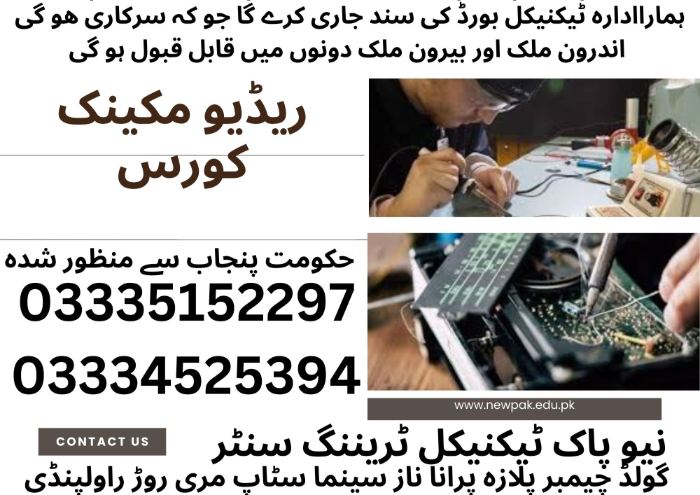
Wireless communication supports security, aviation, marine, and industrial sectors. This course provides practical training in radio repair, RF systems, transmitter and receiver circuits, antenna installation, and digital communication equipment. Students develop hands-on skills in diagnostics, component testing, soldering, and fault detection. With growing demand in Pakistan and Gulf markets, qualified radio mechanics can secure roles in telecom, security services, airports, maritime operations, or establish independent repair businesses, ensuring long-term technical career growth.
Course Overview
An Electrical Supervisor is responsible for more than just wiring; They manage teams, ensure safety compliance, and oversee the technical integrity of entire projects. At New Pak Technical Training Centre , our Electrical Supervisor course is designed to transition you from a technician to a leader. This program covers advanced electrical theory, site management, and international safety codes.
Why Choose Our Radio Mechanic Program?
Specialized Electronics Training: Gain deep knowledge of circuit boards, transistors, and signal processing.
Precision Diagnostic Tools: Learn to use Oscilloscopes, Signal Generators, and Spectrum Analyzers.
High-Security Demand: Skilled mechanics are needed for police communication systems, private security firms, and aviation ground support.
Global Opportunities: This is a niche skill highly valued in the Gulf and Maritime industries for maintaining ship-to-shore and air-to-ground radio equipment.
Detailed Course Modules
06 | Months Certificate
Focus: Fundamental electronics and receiver technology.
Electronic Components: Testing and replacing resistors, capacitors, inductors, and diodes on communication boards.
Radio Frequency (RF) Basics: Understanding AM/FM modulation, frequency bands, and signal propagation.
Receiver Circuits: Troubleshooting audio output, tuning stages, and power supply units.
Antenna Systems: Installation and alignment of various antenna types for maximum signal strength
01 | Year Certificate
Focus: Transceivers, digital communication, and advanced diagnostics.
Two-Way Radios (Walkie-Talkies): Programming, frequency setting, and hardware repair for VHF/UHF handsets.
Transmitter Technology: Mastering the power amplifier stages and modulation circuits of wireless transmitters.
Digital Communication: Introduction to digital radio standards and computerized signal processing.
Advanced Troubleshooting: Using an Oscilloscope to track signal flow and identify dead zones in a circuit
Frequently Asked Questions (FAQs)
Is This Course Only About Old Radios?
No. While we teach the fundamentals using traditional circuits, the focus is on modern wireless equipment, including security Walkie-Talkies and industrial communication sets.
What Kind of Jobs Can I Get?
You can work as a technician in telecommunication companies, security agencies, airport ground staff, or start your own specialized electronic repair lab.
Do I Need to Be Good at Physics?
A basic understanding of electricity is helpful, but we teach you the specific physics of radio waves and electronics in a very practical, easy-to-understand way.