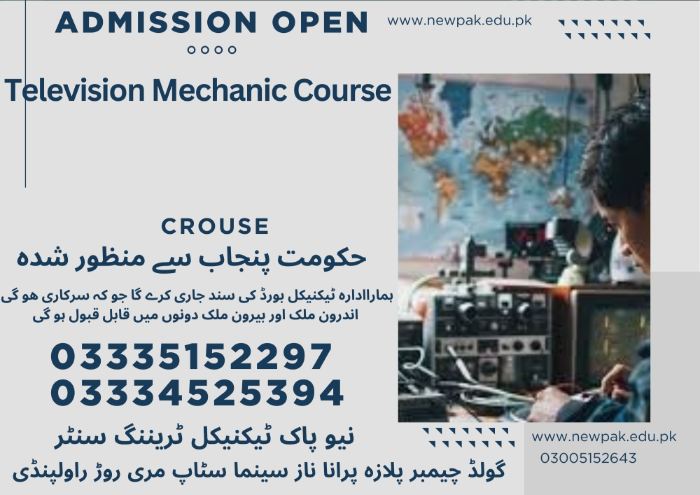
The Television Mechanic Course in Pakistan at New Pak Technical Training Centre is a complete hands-on program designed to produce skilled technicians for modern display technology. Students gain practical expertise in repairing LED, LCD, OLED, and Smart TVs at the chip level, including power supply, backlight, T-Con, and motherboard diagnostics. The course also covers Smart TV software, firmware updates, and advanced panel recovery techniques. Graduates are equipped to work professionally in Pakistan or the Gulf, with the potential to open specialized repair centers.
Course Overview
The days of bulky CRT televisions are gone. Today’s screens are sophisticated pieces of technology featuring ultra-thin panels, smart processors, and complex software. At New Pak Technical Training Centre, our Television Mechanic course takes you into the heart of modern display technology. We provide 100% practical training on LED, LCD, OLED, and Android Smart TVs, turning you into a “Chip-Level” expert who can fix what others simply replace.
Why Choose Our TV Repair Program?
Chip-Level Mastery: Move beyond just swapping boards. Learn to identify and replace individual micro-components (ICs, Capacitors, Mosfets) to save clients’ money.
Panel Repair Specialist: Master the high-demand skill of repairing screen “bonding” issues, lines on display, and backlight failures using specialized tools.
Smart TV Software Training: Learn to update firmware, bypass Google locks, and re-program EMMC/Flash ICs using professional programmers like RT809H.
Global Tech Opportunities: Certified LED technicians are in high demand across Pakistan and the Gulf (Saudi Arabia, UAE), with many graduates starting their own specialized service centers
Detailed Course Modules
06 | Months Certificate
Focus: Master the hardware and common fault repairs.
Electronic Fundamentals: Mastery of the Multimeter, SMD Rework Station, and testing of basic components (Diodes, Regulators).
Power Supply (SMPS) Repair: Troubleshooting “No Power” issues and repairing complex switching power boards.
Backlight Circuitry: Diagnosing LED string failures, removing panels safely, and replacing LED beads or strips.
Assembly & Disassembly: Professional techniques to open modern bezel-less TVs without damaging the fragile glass.
01 | Year Certificate
Focus: Software, OLED technology, and advanced panel recovery.
T-Con & COF Repair: Solving “No Picture,” “Vertical Lines,” and “Ghost Image” problems by repairing Timing Controller boards and Chip-on-Flex (COF).
Software & Firmware: Flashing Android TV OS, working with Universal Boards, and using BIOS programmers to unbrick devices.
OLED & 4K/8K Technology: Understanding the unique self-lit pixel technology of OLEDs and the high-speed data paths of 8K displays.
Frequently Asked Questions (FAQs)
Is TV Repair Still a Profitable Business?
Yes! Modern Smart TVs are expensive. Most customers prefer repairing a screen or board for a fraction of the cost rather than buying a new TV, creating a constant flow of high-profit work.
Can I learn this without an engineering background?
Absolutely. We start with “Basic Electronics 101.” If you have good eyesight and a steady hand, we will teach you the technical science step-by-step.
What Tools Will I Need to Start My Own Shop?
During the course, we show you the essential kit: a Digital Multimeter, an SMD Rework Station, a Panel Tester, and a Software Programmer. We also guide you on where to buy these at wholesale prices.
Month 1 — Introduction & Basic Electronics
1. Theory
Overview of Television Technology
Types of Television: CRT, LED, LCD, Plasma, OLED, Smart TVs
Basic Electrical and Electronic Concepts: Voltage, Current, Resistance
Ohm’s Law and Power Calculations
Safety Rules and Precautions while working with TV circuits