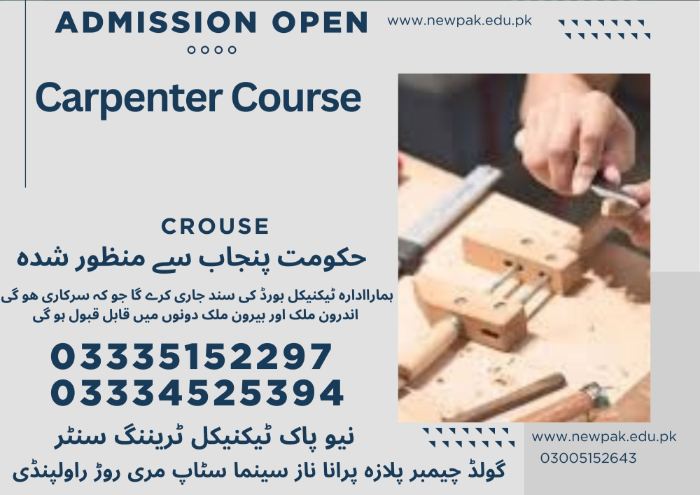
Start your professional journey with the Carpentry Course in Pakistan at New Pak Technical Training Centre. Gain hands-on skills in modern woodworking, furniture design, and structural carpentry in fully equipped workshops. Earn a recognized certification that prepares you for high-demand jobs, home-based businesses, and Gulf opportunities in construction and interior finishing.
Course Overview
From the roofs over our heads to the furniture in our homes, carpentry is an essential trade that combines physical skill with artistic precision. At New Pak Technical Training Centre, our Carpentry course teaches you how to transform raw timber into beautiful, functional structures. We focus on modern woodworking techniques, furniture design, and industrial-scale construction carpentry.
Why Choose Our Carpentry Program?
80% Practical Workshop Time: Our training is conducted in a fully equipped woodworking lab where you work with real timber every day.
Furniture & Structural Training: Learn to make everything from intricate cabinets and chairs to heavy-duty door frames and roof trusses.
Modern Machine Skills: Master the safe operation of Band Saws, Circular Saws, and Thickness Planers, moving beyond just hand tools.
High Demand in the Gulf: Skilled carpenters are highly paid in Dubai, Saudi Arabia, and Kuwait for interior finishing and construction roles.
Detailed Course Modules
06 | Months Certificate
Focus: Hand tools, basic joints, and domestic woodwork.
Tool Mastery: Precision use of Hand Saws, Jack Planes, Chisels, and Marking Gauges.
Wood Identification: Learning to distinguish between local timbers (Shisham, DIYAR, Pine) and artificial boards (MDF, Chipboard).
Joinery Techniques: Creating essential joints like Mortise and Tenon, Dovetails, and Lap Joints for strong furniture.
Hardware & Fitting: Professional installation of hinges, locks, and handles for doors and cabinets.
01 | Year Certificate
Focus: Advanced furniture, interior decor, and site carpentry.
Furniture Design: Reading architectural sketches and building modern furniture (beds, tables, and kitchen cabinets).
Building Carpentry: Constructing wooden partitions, false ceilings, and roof frameworks.
Surface Finishing: Techniques for sanding, staining, and professional polishing (Varnish/Paint).
Estimation & Costing: Learning to calculate “Cubic Foot” (CFT) of wood and prepare a Bill of Quantities (BOQ) for clients.
Frequently Asked Questions (FAQs)
Do I need to be Strong to Be a Carpenter?
This course is ideal for those who already have a basic understanding of electricity or work experience as an electrician. It is a “promotion-level” course designed to help you reach a higher salary grade.
Can I Start My Own Shop After This Course?
Absolutely. Most of our students go on to open their own furniture workshops or become independent contractors for home renovations.
Is There a Job Market for This in The Middle East?
Yes. “Finishing Carpenters” and “Formwork Carpenters” are in high demand for the massive hotel and housing projects in Saudi Arabia and the UAE.
Month 1 — Introduction & Basics of Carpentry
Theory Topics
1. Introduction to Carpentry
History of Carpentry in Pakistan and worldwide
Importance of carpentry in construction and furniture
2. Tools of Carpentry
Hand tools: Hammer, Chisel, Saw, Screwdriver, Mallet