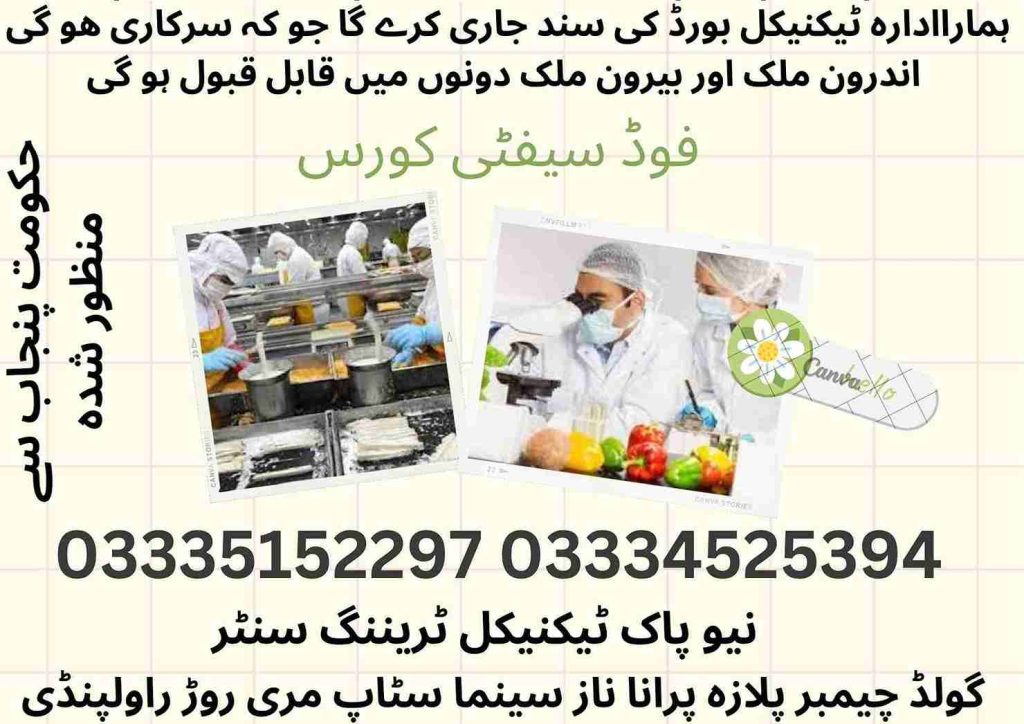
Food safety is essential for public health and regulatory compliance, as improper handling or storage can cause illnesses, legal issues, and reputational damage. The Food Safety Course at New Pak Technical Training Centre provides practical skills and theoretical knowledge to manage, inspect, and maintain safe food practices across restaurants, factories, catering services, and retail outlets. With rising hygiene standards in Pakistan and abroad, trained professionals are in high demand, opening career opportunities as Food Safety Officers, Quality Control Inspectors, or food safety consultants, while ensuring compliance with national and international regulations.
Course Overview
Scaffolding is the backbone of any major construction site, but it is also one of the most dangerous structures if not managed correctly. At New Pak Technical Training Centre, our Scaffolding Inspector course prepares you to be the “Competent Person” responsible for the life and limb of every worker above the ground. You will learn to perform rigorous inspections, identify structural weaknesses, and certify that a scaffold is safe for use according to international laws.
Why Choose Our Scaffolding Inspector Program?
International Compliance: Our curriculum is built on OSHA 29 CFR 1926.451 and BS EN 12811 (British/European) standards, ensuring your certification is recognized globally.
Tagging System Authority: Master the professional “Scaff-Tag” system (Red/Yellow/Green) to control site access and ensure compliance.
High-Risk Industry Ready: This course is a mandatory requirement for safety roles in the Oil & Gas, Petrochemical, and High-Rise Construction sectors in Saudi Arabia, the UAE, and Qatar.
Load Physics & Engineering: Learn the math behind a safe build, calculating load-bearing capacities and height-to-base ratios.
Detailed Course Modules
06 | Months Certificate
Focus: Foundations of scaffold components and basic inspection.
Scaffold Terminology: Identifying standards, ledgers, transoms, couplers, base plates, and mudsills.
Component Inspection: Learning to spot damaged tubes, warped boards, or faulty fittings before they are used in a build.
Foundations & Ground Conditions: Assessing soil stability and the use of sole boards to prevent “sinking” or “unbalanced” structures.
Basic Guardrail Systems: Ensuring top rails, mid-rails, and toe-boards meet height and strength requirements.
01 | Year Certificate
Focus: Complex structures, load calculations, and supervisory management.
Advanced Scaffold Types: Inspection of Cantilever, Suspended, Mobile Towers, and Birdcage scaffolds.
Load Calculations: Calculating the “Duty Rating” (Light, General, or Heavy Duty) and ensuring the structure can support 4 times its intended load.
Stability & Tie Rules: Mastering the 4:1 Height-to-Base ratio and the correct placement of “Positive Ties” to permanent structures.
Fall Protection Systems: Verifying the integrity of Personal Fall Arrest Systems (PFAS) and safety netting.
Legal Documentation: Maintaining the “Scaffold Register” and conducting mandatory 7-day re-inspections.
Frequently Asked Questions (FAQs)
Do I Need To Be A Professional Scaffolder To Join This Course?
While experience in construction helps, it is not mandatory. This course is for those who want to inspect and manage the safety of the work, rather than just the physical labor of erecting it.
How Often Must A Scaffold Be Inspected?
According to international standards, a scaffold must be inspected before first use, at least every 7 days thereafter, and after any occurrence (like high winds or an accident) that could affect its stability.
Is There A Job Market For This In Pakistan?
Yes. Major infrastructure projects, dams, and multi-story plazas in cities like Rawalpindi and Karachi now require dedicated Scaffolding Inspectors to comply with modern insurance and safety laws.
Month 1 — Introduction To Food Safety
1. Theory
Introduction to Food Safety
Importance of Food Safety in Public Health
Foodborne Illnesses & Outbreaks
Food Safety Terminology
Role of Food Safety Officer
Food Chain (Farm to Fork Concept)
Types of Food (Raw, Cooked, Processed)
Food Contamination Sources
Microorganisms in Food
Basics of Nutrition & Food Quality
2. Practical
Personal hygiene demonstration
Hand washing techniques
Use of protective clothing
Clean & safe food handling practices
Identification of contaminated food samples
Month 2 — Food Hazards & Contamination
1. Theory
Biological Hazards (Bacteria, Viruses, Parasites)
Chemical Hazards (Pesticides, Additives, Cleaning Chemicals)
Physical Hazards (Glass, Metal, Stones)
Cross Contamination
Allergens & Food Intolerance
Food Spoilage Causes
Temperature Control & Danger Zone
Safe Storage of Food
Food Safety Signs & Symbols
2. Practical
Hazard identification exercises
Cross-contamination control methods
Food storage inspection
Temperature measurement practice
Cleaning & sanitizing food contact surfaces
Month 3 — Food Safety Standards & Laws (Pakistan)
1. Theory
Pakistan Food Laws & Regulations
Punjab Food Authority (PFA) Rules
Sindh Food Authority (SFA)
KP Food Safety Authority
Balochistan Food Authority
International Standards (WHO, FAO, Codex)
ISO 22000 Introduction
Food Labeling Laws
Consumer Rights & Responsibilities
2. Practical
Food label checking
Legal compliance checklist
Food safety documentation practice
Mock food inspection
Month 4 — Haccp & Food Safety Management System
1. Theory
Introduction to HACCP
Seven Principles of HACCP
Hazard Analysis
Critical Control Points (CCPs)
Critical Limits
Monitoring Procedures
Corrective Actions
Verification & Validation
Record Keeping
Good Manufacturing Practices (GMP)
2. Practical
HACCP plan development
CCP identification
Monitoring records preparation
GMP & GHP checklist practice
Food processing flow diagram preparation
Month 5 — Food Handling, Storage & Transportation
1. Theory
Safe Food Handling Techniques
Cooking, Cooling & Reheating Rules
Cold Storage & Freezing Methods
Dry Storage Practices
Food Packaging Materials
Food Transportation Safety
Pest Control Methods
Waste Management
Cleaning & Sanitation Procedures
2. Practical
Cooking temperature practice
Storage area inspection
Packaging material identification
Pest control demonstration
Month 6 — Food Safety Inspection & Career Preparation